Duration Judgments with Conflicting Audiovisual Cues
Overview
How does the brain integrate conflicting temporal information across sensory modalities? Previous work has shown that observers integrate audiovisual duration cues close to optimally when cue conflict is small. This project asks whether causal inference causes audiovisual integration to break down when the conflict becomes large.
In this task, participants compared the auditory durations of a test and a standard stimulus. Audiovisual durations were matched in the test stimulus, while the standard stimulus contained seven levels of audiovisual conflict spanning -250 ms to +250 ms. Auditory durations were tested under both low- and high-noise conditions.
The main pattern was a systematic shift in auditory duration judgments toward the visual cue, especially when auditory noise was high. Within the tested conflict range, these shifts were close to linear, making it difficult to clearly separate forced-fusion, causal-inference, and probabilistic switching models.
Experiment Materials
Unimodal Timeline
Conflict Design
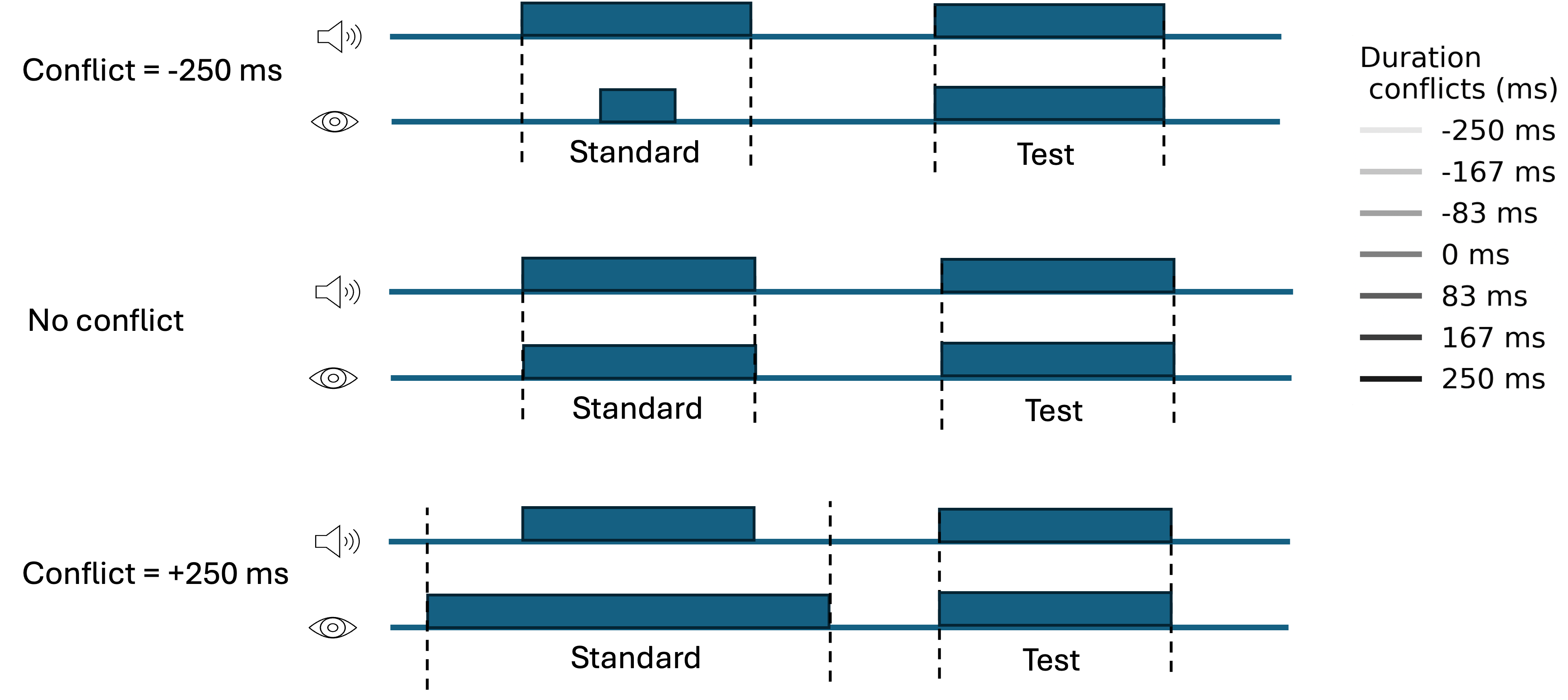
Conflicts were introduced only in the visual component of the standard stimulus, while the auditory component remained unchanged. Negative conflicts made the visual standard shorter than the auditory standard; positive conflicts made it longer.
Crossmodal Reference
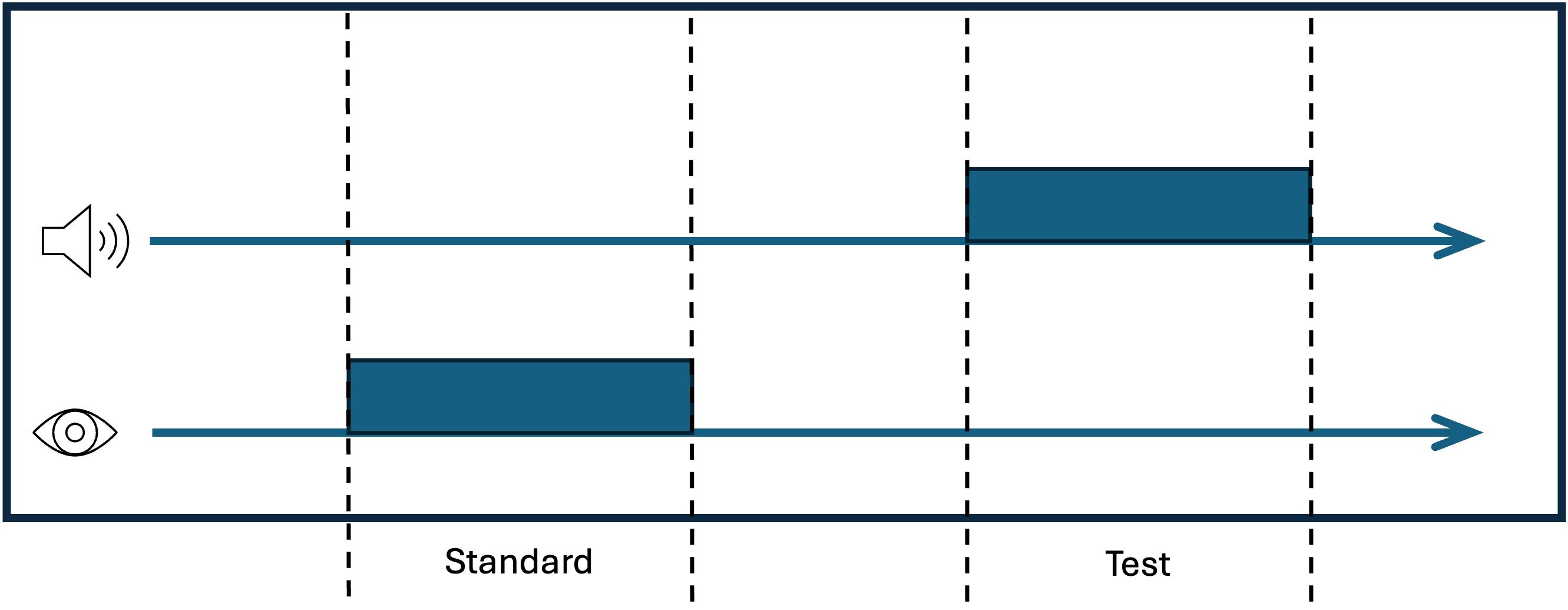
The crossmodal task provided an estimate of audiovisual bias, which was then used to correct visual durations in the bimodal experiment.
Psychometric Fits
Model Comparison
Demo Videos
Unimodal Auditory
Visual Demo
Crossmodal Demo
Bimodal Demo
Summary
Auditory duration percepts were biased toward visual duration, and that bias increased with cue conflict and auditory uncertainty. A probabilistic cue-switching account was preferred for many participants, but the differences between candidate models remained small because auditory duration encoding was noisy enough to make their predictions overlap strongly in the tested regime.